A seed (help·info) (in some plants, referred to as a kernel) is a small embryonic plant enclosed in a covering called the seed coat, usually with some stored food.
It is the product of the ripened ovule of gymnosperm and angiosperm plants which occurs after fertilization and some growth within the mother plant.
The formation of the seed completes the process of reproduction in seed plants (started with the development of flowers and pollination), with the embryo developed from the zygote and the seed coat from the integuments of the ovule.
Seeds have been an important development in the reproduction and spread of flowering plants, relative to more primitive plants like mosses, ferns and liverworts, which do not have seeds and use other means to propagate themselves.
This can be seen by the success of seed plants (both gymnosperms and angiosperms) in dominating biological niches on land, from forests to grasslands both in hot and cold climates.
The term seed also has a general meaning that predates the above — anything that can be sown i.e. "seed" potatoes, "seeds" of corn or sunflower "seeds".
In the case of sunflower and corn "seeds", what is sown is the seed enclosed in a shell or hull, and the potato is a tuber.
2008年11月28日星期五

Telemea
Telemea is the name of the traditional Romanian cheese.
The term encompasses cheese made out of cow milk and more often, sheep milk.
As is the case in Greek feta, Bulgarian/Macedonian sirene, and Serbian sir; Telemea can have a higher water content, making it a semi-soft, white cheese with a creamy texture and a tangy aftertaste.
Alternatively, the cheese is put through an ageing process that makes it crisper and more flavoured. It is used as a table cheese for snacks, in salads and in a variety of dishes (e.g., omelettes, crepes, pies). Cumin seeds are occasionally added for a spicy, nutty flavor.
To make telemea cheese, rennet is added into milk to curdle it.
Most commonly, cow's and sheep's milk is used, with goat's and buffalo's being more of a delicacy. The resulting curd is removed and is kept in cheesecloth, pressed overnight, then cut into square pieces.
The cheese is then left to mature in brine. This fresh cheese (preserved in brine up to a couple of weeks) has its own name, caş. Subsequently, it is stored in wooden barrels named putini
It can be kept throughout winter in a more concentrated brine. In this case, it is desalted in fresh water before consumption.
The term encompasses cheese made out of cow milk and more often, sheep milk.
As is the case in Greek feta, Bulgarian/Macedonian sirene, and Serbian sir; Telemea can have a higher water content, making it a semi-soft, white cheese with a creamy texture and a tangy aftertaste.
Alternatively, the cheese is put through an ageing process that makes it crisper and more flavoured. It is used as a table cheese for snacks, in salads and in a variety of dishes (e.g., omelettes, crepes, pies). Cumin seeds are occasionally added for a spicy, nutty flavor.
To make telemea cheese, rennet is added into milk to curdle it.
Most commonly, cow's and sheep's milk is used, with goat's and buffalo's being more of a delicacy. The resulting curd is removed and is kept in cheesecloth, pressed overnight, then cut into square pieces.
The cheese is then left to mature in brine. This fresh cheese (preserved in brine up to a couple of weeks) has its own name, caş. Subsequently, it is stored in wooden barrels named putini
It can be kept throughout winter in a more concentrated brine. In this case, it is desalted in fresh water before consumption.
Coriander
History
Coriander grows wild over a wide area of the Near East and southern Europe, which forced Zohary and Hopf to admit that "it is hard to define exactly where this plant is wild and where it only recently established itself."
Coriander grows wild over a wide area of the Near East and southern Europe, which forced Zohary and Hopf to admit that "it is hard to define exactly where this plant is wild and where it only recently established itself."
fteen desiccated mericarps were found in the Pre-Pottery Neolithic B level of the Nahal Hemel Cave in Israel, which may be the oldest archeological find of coriander.
About half a litre of coriander mericarps were recovered from the tomb of Tutankhamun, and because this plant does not grow wild in Egypt, Zohary and Hopf interpret this find as proof that coriander was cultivated by the ancient Egyptians.
The Bible mentions coriander in Exodus 16:31: "And the house of Israel began to call its name Manna: and it was round like coriander seed, and its taste was like that of flat cakes made with honey."
Coriander seems to have been cultivated in Greece since at least the second millennium BC. One of the Linear B tablets recovered from Pylos refers to the species as being cultivated for the manufacture of perfumes, and it appears that it was used in two forms: as a spice for its seeds and as a herb for the flavour of its leaves.
Coriander seems to have been cultivated in Greece since at least the second millennium BC. One of the Linear B tablets recovered from Pylos refers to the species as being cultivated for the manufacture of perfumes, and it appears that it was used in two forms: as a spice for its seeds and as a herb for the flavour of its leaves.
This appears to be confirmed by archaeological evidence from the same period: the large quantities of the species retrieved from an Early Bronze Age layer at Sitagroi in Macedonia could point to cultivation of the species at that time . Coriander is thought to have been introduced to Britain by the Romans as a meat preserver
Coriander seed and leaf was very widely used in medieval European cuisine, due to its ability to make spoiled meats palatable by "masking" rotten flavours. Even today, coriander seed is an important ingredient in many sausage products.
Coriander was brought to the British colonies in North America in 1670 and was one of the first spices cultivated by early settlers.
Coriander was brought to the British colonies in North America in 1670 and was one of the first spices cultivated by early settlers.
Fruit

The dry fruits are known as coriander seeds or coriandi seeds. In some regions, the use of the word coriander in food preparation always refers to these seeds (as a spice), rather than to the plant itself. The seeds have a lemony citrus flavour when crushed, due to the presence of the terpenes linalool and pinene. It is also described as warm, nutty, spicy, and orange-flavoured. They are usually dried but can be eaten green.
It is commonly found both as whole dried seeds and in ground form. Seeds can be roasted or heated on a dry pan briefly before grinding to enhance and alter the aroma. Like most spices, ground coriander seed loses its flavour quickly in storage and is best when ground as needed. For optimum flavour, whole coriander seed should be stored in a tightly sealed container away from sunlight and heat.
Coriander seed is a key spice in garam masala and Indian curries, which often employ the ground fruits in generous amounts together with cumin. It also acts as a thickener. Roasted coriander seeds, called dhana dal, are also eaten as a snack. It is also the main ingredient of the two south Indian gravies: sambhar and rasam.
Outside of Asia, coriander seed is an important spice for pickling vegetables, and making sausages in Germany and South Africa (see boerewors). In Russia and Central Europe coriander seed is an occasional ingredient in rye bread as an alternative to caraway. Apart from the uses just noted, coriander seeds are uncommonly used in European cuisine today, though they were more important in former centuries.
Coriander seeds are also used in brewing certain styles of beer, particularly some Belgian wheat beers. The coriander seeds are typically used in conjunction with orange peel to add a citrus character to these styles of beer.
Roots
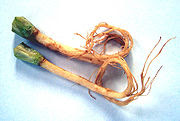
Coriander roots
Coriander roots are used in a variety of Asian cuisine. They are commonly used in Thai dishes.
It is commonly found both as whole dried seeds and in ground form. Seeds can be roasted or heated on a dry pan briefly before grinding to enhance and alter the aroma. Like most spices, ground coriander seed loses its flavour quickly in storage and is best when ground as needed. For optimum flavour, whole coriander seed should be stored in a tightly sealed container away from sunlight and heat.
Coriander seed is a key spice in garam masala and Indian curries, which often employ the ground fruits in generous amounts together with cumin. It also acts as a thickener. Roasted coriander seeds, called dhana dal, are also eaten as a snack. It is also the main ingredient of the two south Indian gravies: sambhar and rasam.
Outside of Asia, coriander seed is an important spice for pickling vegetables, and making sausages in Germany and South Africa (see boerewors). In Russia and Central Europe coriander seed is an occasional ingredient in rye bread as an alternative to caraway. Apart from the uses just noted, coriander seeds are uncommonly used in European cuisine today, though they were more important in former centuries.
Coriander seeds are also used in brewing certain styles of beer, particularly some Belgian wheat beers. The coriander seeds are typically used in conjunction with orange peel to add a citrus character to these styles of beer.
Roots
Coriander roots
Coriander roots are used in a variety of Asian cuisine. They are commonly used in Thai dishes.
Uses
All parts of the plant are edible, but the fresh leaves and the dried seeds are the most commonly used in cooking. Coriander is commonly used in Middle Eastern, Mediterranean, Indian, South Asian, Latin American, Chinese, African and Southeast Asian cuisine.
Leaves
The leaves are variously referred to as coriander leaves, cilantro (in the United States and Canada, from the Spanish name for the plant), dhania (in the Indian subcontinent, and increasingly in Britain), Kothimir(a) in Telugu, kindza (in Georgia), Chinese parsley or Mexican parsley. The leaves have a very different taste from the seeds, similar to parsley but "juicier" and with citrus-like overtones. Some people perceive an unpleasant "soapy" taste and/or a rank smell. Contrary to popular opinion, there is no evidence that there is a genetic basis to this taste perception; instead, it appears to be linked to exposure. The leaves spoil quickly when removed from the plant, and lose their aroma when dried or frozen.
The fresh leaves are an essential ingredient in many South Asian foods (particularly chutneys) and Mexican salsas and guacamole. Chopped coriander leaves are also used as a garnish on cooked dishes such as dal and many curries. As heat diminishes their flavour quickly, coriander leaves are often used raw or added to the dish right before serving. In some Indian and Central Asian recipes, coriander leaves are used in large amounts and cooked until the flavour diminishes.
Coriander leaves were formerly common in European cuisine but nearly disappeared before the modern period. Today western Europeans usually eat coriander leaves only in dishes that originated in foreign cuisines, except in Portugal, where it is still an essential ingredient in many traditional dishes.
Leaves
The leaves are variously referred to as coriander leaves, cilantro (in the United States and Canada, from the Spanish name for the plant), dhania (in the Indian subcontinent, and increasingly in Britain), Kothimir(a) in Telugu, kindza (in Georgia), Chinese parsley or Mexican parsley. The leaves have a very different taste from the seeds, similar to parsley but "juicier" and with citrus-like overtones. Some people perceive an unpleasant "soapy" taste and/or a rank smell. Contrary to popular opinion, there is no evidence that there is a genetic basis to this taste perception; instead, it appears to be linked to exposure. The leaves spoil quickly when removed from the plant, and lose their aroma when dried or frozen.
The fresh leaves are an essential ingredient in many South Asian foods (particularly chutneys) and Mexican salsas and guacamole. Chopped coriander leaves are also used as a garnish on cooked dishes such as dal and many curries. As heat diminishes their flavour quickly, coriander leaves are often used raw or added to the dish right before serving. In some Indian and Central Asian recipes, coriander leaves are used in large amounts and cooked until the flavour diminishes.
Coriander leaves were formerly common in European cuisine but nearly disappeared before the modern period. Today western Europeans usually eat coriander leaves only in dishes that originated in foreign cuisines, except in Portugal, where it is still an essential ingredient in many traditional dishes.
Coriander
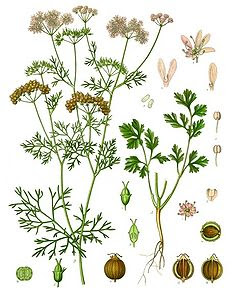
Coriander (Coriandrum sativum), also commonly called cilantro, is an annual herb in the family Apiaceae. Coriander is native to southwestern Asia west to north Africa.
It is a soft, hairless plant growing to 50 cm tall. The leaves are variable in shape, broadly lobed at the base of the plant, and slender and feathery higher on the flowering stems.
The flowers are borne in small umbels, white or very pale pink, asymmetrical, with the petals pointing away from the centre of the umbel longer (5-6 mm) than those pointing to the middle of the umbel (only 1-3 mm long).
The fruit is a globular dry schizocarp 3-5 mm diameter.
The name coriander derives from French coriandre through Latin “coriandrum” in turn from Greek “κορίαννον”.John Chadwick notes the Mycenaean Greek form of the word, koriadnon "has a pattern curiously similar to the name of Minos' daughter Ariadne, and it is plain how this might be corrupted later to koriannon or koriandron."
The name coriander derives from French coriandre through Latin “coriandrum” in turn from Greek “κορίαννον”.John Chadwick notes the Mycenaean Greek form of the word, koriadnon "has a pattern curiously similar to the name of Minos' daughter Ariadne, and it is plain how this might be corrupted later to koriannon or koriandron."
Radhuni
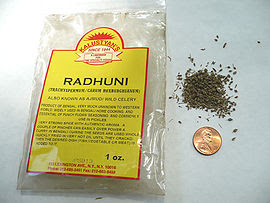
Seeds of Trachyspermum roxburghianum (also known as Carum roxburghianum) is a flowering plant in the family Apiaceae.
Its seeds, which are related to the spice ajwain, are often used in Indian cuisine. It is grown extensively in the South Asia, Southeast Asia, and Indonesia.
Radhuni is also known as wild celery in English or ajmod in Urdu and Hindi. It is a very strong spice, with a characteristic smell similar to parsley.
Radhuni is also known as wild celery in English or ajmod in Urdu and Hindi. It is a very strong spice, with a characteristic smell similar to parsley.
A couple of pinches can easily overpower a curry.
In Bengali cuisine the seeds are used whole, quickly fried in very hot oil until they crackle.
They are part of a local panch phoron (Bengali five spice) mixture, where they replace the more commonly used mustard seed; the other ingredients are cumin seed, fenugreek seed, fennel seed, and kalonji (often wrongly called "wild onion seed," and known locally (though erroneously) as "black cumin seed" Nigella sativa; see also Bunium persicum). In other places, a common use is in pickles or spice mixtures.
订阅:
博文 (Atom)